Readers' favourite Alex Cartoons

Every Monday we feature a favourite Alex cartoon selected by our readers.
27th October sees the 40th anniversary of Big Bang: the deregulation of financial markets which created the modern City of London. It was the culture of greed and excess unleashed by these changes that inspired us to start Alex, so we decided this week to temporarily suspend the readers’ choice and pick an appropriate cartoon to mark the occasion.
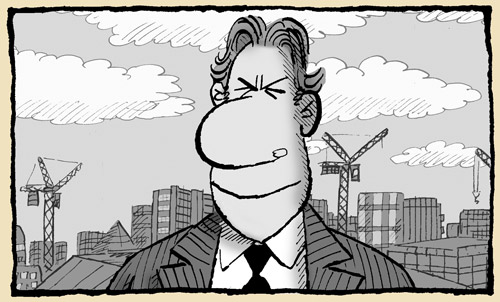
Having said that, our two-framer cartoons, like this one from 1992, have always been popular with readers. We’d have made them a more regular feature, only they are very greedy on puns and hoover up a whole week’s worth of them in one strip. This cartoon uses the dual significance of (the) Big Bang to draw a parallel between astrophysics and the Docklands property development in East London.
The Daily Telegraph, despite its fuddy-duddy reputation, was surprisingly progressive back in those days. It was the first British newspaper to have a website (The Electronic Telegraph) and among the first to move out of the traditional press hub of Fleet Street into new premises in Canary Wharf. Both innovations went down badly with its journalists, who resented being forced to schlep out to the Isle of Dogs and the extra shifts they had to put in to produce content for the new-fangled online edition (this internet fad would never last, many of them confidently predicted).
Docklands today abounds with coffee shops, wine bars and restaurants, but when the Telegraph relocated there in the late 1980s it was a grim place. It had virtually no public transport infrastructure and only one pub, which was usually full of ex-dockers who didn’t take kindly to journalists. When this cartoon ran in April 1992, Alex had only recently switched to the Telegraph, and we noted how positively our journalist colleagues responded to any jokes we ran bashing Docklands. We should mention that we had our own studio in Soho and rarely had to venture out East, so our cartoons on the subject were tinged with a certain smugness.
Jodrell Bank in Cheshire is the home of what was, for many years, the world’s largest radio telescope. It was founded in 1945 by physicist Sir Bernard Lovell, who like many highly intelligent people of that era sported an unconvincing combover. Jodrell Bank was an iconic institution for all schoolboys of our generation who loved sci-fi and spy novels, as not only did it detect Black Holes, but it also monitored Soviet rocket launches. Due to cutbacks in science funding it is now threatened with closure, leading to the possibility that in the future its name may survive merely as a piece of rather rude cockney rhyming slang.
If you’re feeling nostalgic for the Big Bang era, our new book “The Best of Alex in the 80s" is available for pre-order now.
Click on the cartoon above to see it in its original 1990s context.
If you’ve got any suggestions for a favourite cartoon for future inclusion please email us. And do tell us if there’s a particular reason why it appealed to you.